Special Issue - Science communication: Making research accessible - Science meets art: A story of curiosity and collaboration
Artists can not only help present scientific research in a novel way but also encourage deeper and more reflective responses from the public. At Papiliorama, more than 3,000 visitors experienced interactive installations, and the response was both exciting and thought-provoking. Yes, science and art can go together very well!
SciArt is a non-profit organisation in Switzerland devoted to the fusion of discovery and creativity, founded in 2024. We had many ideas and a history of science–art collaborations behind us, and wanted to explore more novel ideas around science communication and public engagement. Over the last year, our plans for new projects have become increasingly concrete, and we have started collaborations with environmental scientists and biologists as well as with researchers in the physical sciences. Apart from looking for funding, we also began to consider possible exhibition venues.
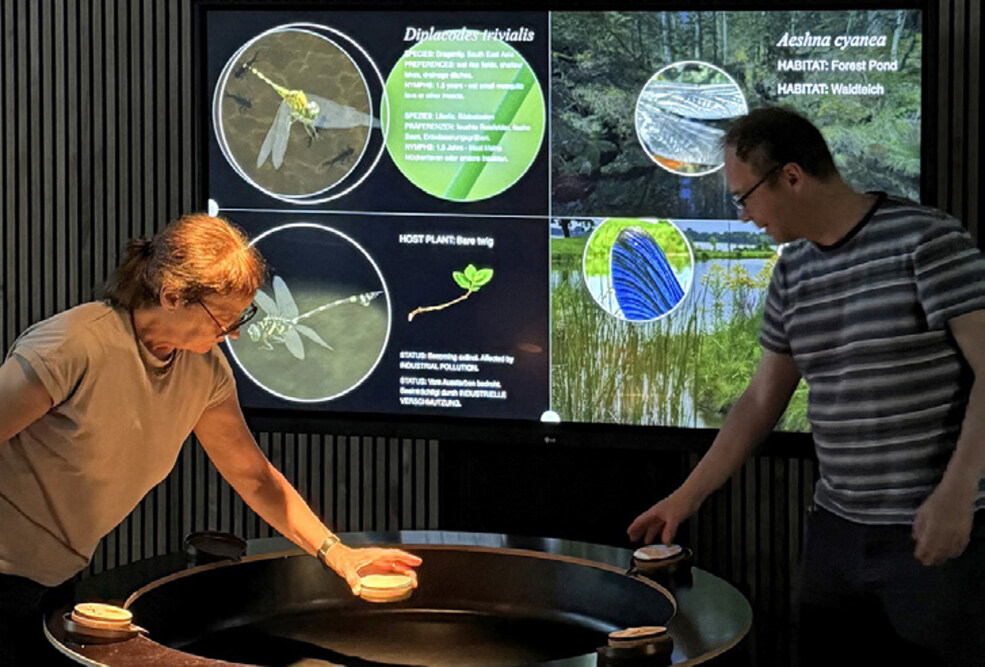
Toni Fröhlich, co-founder of SciArt, first contacted Papiliorama, a small science centre with a zoo and botanical garden housing a large collection of tropical butterflies just west of Bern. The centre might be unknown to international audiences, but in Switzerland it is popular among families and the wider public. The centre was keen to collaborate with us at SciArt, as biodiversity is one of its core areas of interest and closely aligns with our project. Using different electronic media and interactive installations, such as those in Jill Scott's works, was also new for them. Moreover, the centre had just constructed a new building that could host our exhibition Water Stories.
Different backgrounds, one goal
Toni has a background in nanoscience and the laboratory manufacturing of nanostructures. He is especially interested in structural colours, a way of creating colours without pigments. It entails engraving nanostructures into a surface, which creates light interferences depending on the wavelength and angle of incidence.
Jill's interests are very broad. With over 40 years of experience in the transdisciplinary field of art, science and technology, she has explored close collaborations between artists and scientists. As an artist, she draws inspiration from scientists to create artworks. She believes that scientists require unique forms of communication and that translating their research into media art can lead to new ways of thinking.
Realising a project together
As a starting point, Jill developed a project called Worried Wings to bridge scientific and artistic disciplines. The dragonfly is one of the main species used to study the fragile biodiversity of ponds and the human impact on freshwater systems. Their wings can show structural colours, further emphasising the beauty of this insect. We planned to mimic these colours on dragonfly sculptures using nanolithography techniques, but have not yet been able to do so due to a lack of funding. This new work, along with others, like Jelleyes about the Great Barrier Reef and LikeWater, a VR game designed by the start-up Somebodyelse were shown as part of Water Stories.
In Brisbane, we presented our plans for the Worried Wings project at ISEA 2024, the International Symposium for Electronic Art. The presentation was included in the academic symposium of the festival. It attracted a lot of interest and provided us with valuable suggestions for the next steps in our journey.
For Toni, the project was an adventurous journey to see how science can be interpreted through artistic works. It was fascinating to see how an idea evolved into a creative work and finally a public exhibition. SciArt develops new methods to help visitors, many of whom have no scientific background, become more curious about science.
How to involve visitors actively
Beyond the show, SciArt also engages the public directly through field-based citizen science. During the exhibition, we held a citizen science hiking workshop in a landscape conservation area with several small lakes. Participants, accompanied by experts, collected water and soil samples, and listened to underwater and subsoil sounds. Auried is situated right next to the Saane river and is famous for its birdlife, one of the largest Swiss populations of frogs, dragonflies and water species.
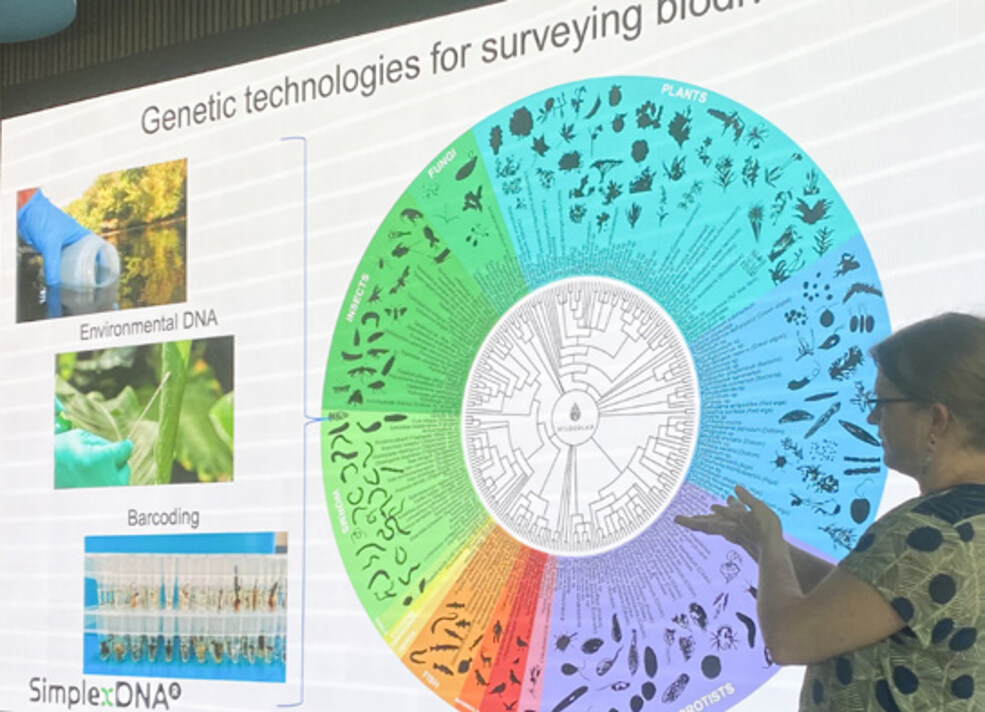
Kristy Deiner, another founding member of SciArt, later analysed the samples for environmental DNA (eDNA) in her company, SimplexDNA. We also had hydrologists teaching participants water observation and artists performing sensory exercises. The results from our hiking workshops were featured in the exhibition.
Another highlight of the exhibition programme was a series of LASER talks, part of the International Society for Arts, Sciences, and Technology Leonardo International. Here, scientists and artists give short presentations about their work, followed by a discussion in which everyone can participate.
Overall, our special exhibition was a success. Papiliorama was delighted to host Water Stories, which brought them valuable experiences that will continue to benefit them in the future. We are now developing a new project on atmospheric physics, Atmosphere One, continuing our mission to connect science and art.
Art–science collaborations open doors to audiences who might never engage with research otherwise, making scientific ideas more relatable, intuitive and memorable.
Art–science collaborations open doors to audiences who might never engage with research otherwise, making scientific ideas more relatable, intuitive and memorable.
Toni Fröhlich
MCAA Switzerland Chapter, Vice-Chair
Jill Scott
Zurich University of the Arts